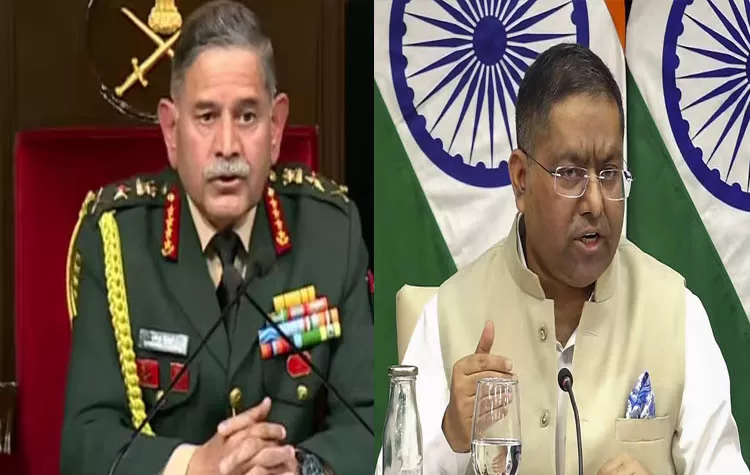
India has once again dismissed China's assertion regarding the Shaksgam Valley. According to Indian Army Chief General Upendra Dwivedi, the 1963 treaty between Pakistan and China is no longer in force. He remarked that the agreement lacks a legal foundation and, thus, can't be recognized by India.
Indian Army Chief Statement
- General Upendra Dwivedi spoke at a press conference held in Delhi and made his remarks. He was answering a query about the Shaksgam Valley dispute when he said that India had not signed the agreement with Pakistan and China in 1963, which divided the valley between them.
- General Upendra Dwivedi went on to say that India would not accept any activity done in that area. He pointed out the case of the China-Pakistan Economic Corridor, which is viewed by India as a project they are both carrying out illegally.
India’s Previous Protest
- On May 9, India made a formal objection regarding the development activities that China was carrying out in the Shaksgam Valley. At the same time, India reiterated its stand on the issue of the 1963 border agreement between Pakistan and China, saying it would not recognize it at all. Additionally, Indian officials confirmed that their claim that the Shaksgam Valley is part of India remains unchanged.
- China, on the other hand, expressed disagreement with India. China asserted that the area is part of its territory and that India has no grounds to object to the conduct of developmental activities there.
Position and Importance of Shaksgam Valley
- The Shaksgam Valley is situated close to the immensely significant Karakoram Highway. Pakistan had, after partition, exercised control over the area. It then ceded the territory to China through the 1963 agreement.
- India contends that Pakistan was not legally entitled to surrender this region. By relinquishing the valley, Pakistan not only conferred China with access to the road but also allowed new developments in the area. The China–Pakistan Economic Corridor now passes through this region, increasing its strategic importance.